Alice

You’ve probably also come across this picture: Newman sits in the middle, surrounded by a circle of tech moguls that have been photoshopped in, as if they were at a company annual meeting.
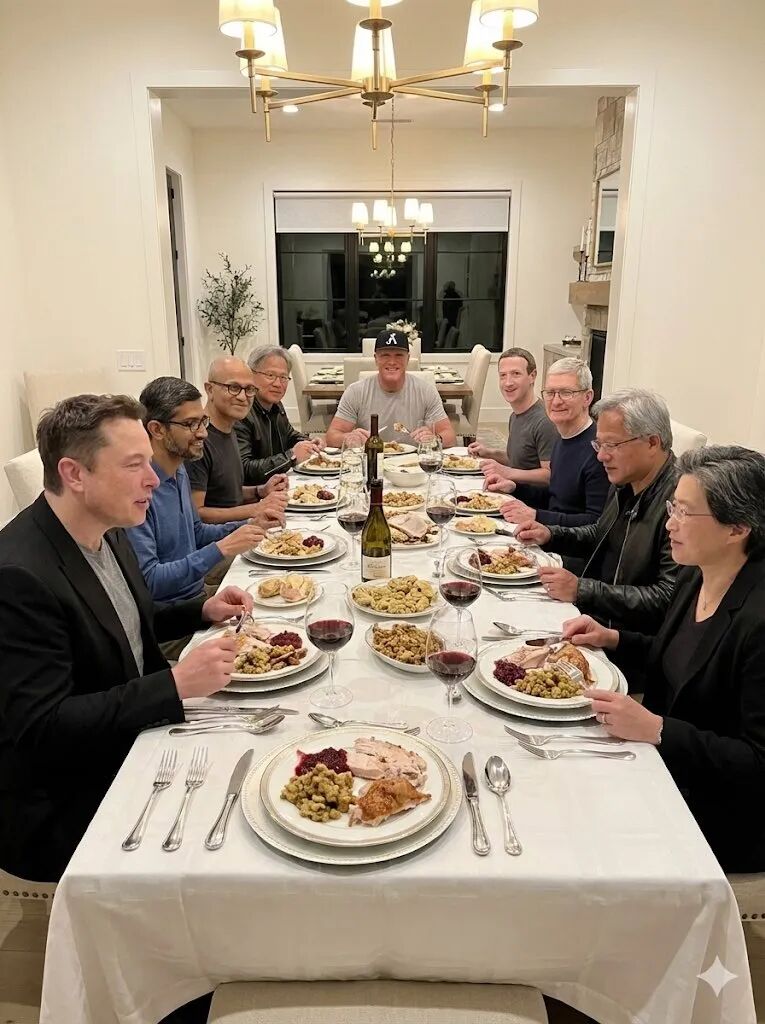
The photo is full of details: a turkey, red wine, and candles are lined up in a row. Next to them are Zuckerberg, Musk, Nadella, Cook, and others, all smiling demurely… The scene is so exquisitely crafted that it resembles a magazine spread. This picture has been rated as one of this year’s most “unexpected” Thanksgiving highlights. Google’s newly launched Nano Banana Pro has made this photo just one BBC watermark away from being a “live report from the scene.” Perhaps in a few years’ time during Thanksgiving, we’ll look at the mashed potatoes in front of us and ask, “Is this AI-generated mashed potatoes?”
This Year’s Thanksgiving Highlights Are Taken Over by AI
This Thanksgiving, what came to the table first wasn’t people but amazing images created by AI. Thanks to AI, RFK Jr. transformed an old McDonald’s group photo into a Thanksgiving version. The fries and burgers have been replaced with Brussels sprouts and cranberries, with Trump Sr. and Jr., Musk, and others all “eating healthily” around the table.

These “celebrity gatherings” have been shared on social media platforms in a dead-serious manner, as if they had really happened. The common feature of these photos is their “overly natural” appearance. The lighting is just right, the skin tones are perfect, and even the light falls exactly where it should. This is the power of Google’s newly introduced Nano Banana Pro. Have you noticed that this year’s Thanksgiving group photos seem to have a different style? Indeed, that’s the case.
A week before Thanksgiving, Google unveiled Nano Banana Pro. Media comments at the time hit the nail on the head: It’s not just generating images; it’s generating scenes that you’ll believe in. Define the production contract.
Agree on expected quality, latency, cost and failure behavior before optimizing components. A service can look efficient in isolation while violating the user-facing objective. Fallback and rejection behavior should be explicit so edge cases do not improvise at runtime.
Make state ownership explicit
Models, caches, queues and databases often hold overlapping representations. Each durable state should have one authoritative owner and a version so stale copies cannot silently win. Test degradation and recovery.
Simulate unavailable dependencies, stale caches and overload. A production system needs predictable fallbacks and a clear path back to normal operation rather than manual repair for every incident.
Instrument the end-to-end path
Measure queueing, execution, retries and final user outcome rather than only component health. Traces should make it possible to explain why a request was slow or wrong from the user’s perspective. Version important configuration.
Prompt templates, model routes and data dependencies can change behavior without code changes. Versioning these inputs makes regressions reproducible and rollback safer.
Prefer bounded failure
When dependencies degrade, reduce optional work or return a clear fallback instead of allowing latency and error rates to cascade through the whole system. Define the production contract.
Agree on expected quality, latency, cost and failure behavior before optimizing components. A service can look efficient in isolation while violating the user-facing objective. Fallback and rejection behavior should be explicit so edge cases do not improvise at runtime.
Make state ownership explicit
Models, caches, queues and databases often hold overlapping representations. Each durable state should have one authoritative owner and a version so stale copies cannot silently win. Test degradation and recovery.
Simulate unavailable dependencies, stale caches and overload. A production system needs predictable fallbacks and a clear path back to normal operation rather than manual repair for every incident.
Define the production contract first
Quality, latency, cost and failure behavior should be explicit before teams optimize individual components. A subsystem can look healthy while violating the end-to-end objective users actually experience.
Fallback and rejection behavior should also be planned so unusual conditions do not improvise at runtime.
Make state ownership and versioning clear
Models, queues, caches and databases often hold overlapping representations. Each durable fact should have one authoritative owner and version so stale copies cannot silently win.


 admin