Alice

According to information on SoftBank Group’s official website, the Group and OpenAI announced on November 5 the formal establishment of a joint venture named SB OAI Japan GK. In a statement, SoftBank stated that SB OAI Japan aims to provide “Crystal Intelligence” solutions, leveraging artificial intelligence technology to revolutionize the management and operational models of Japanese companies. The product is scheduled to officially launch in 2026.
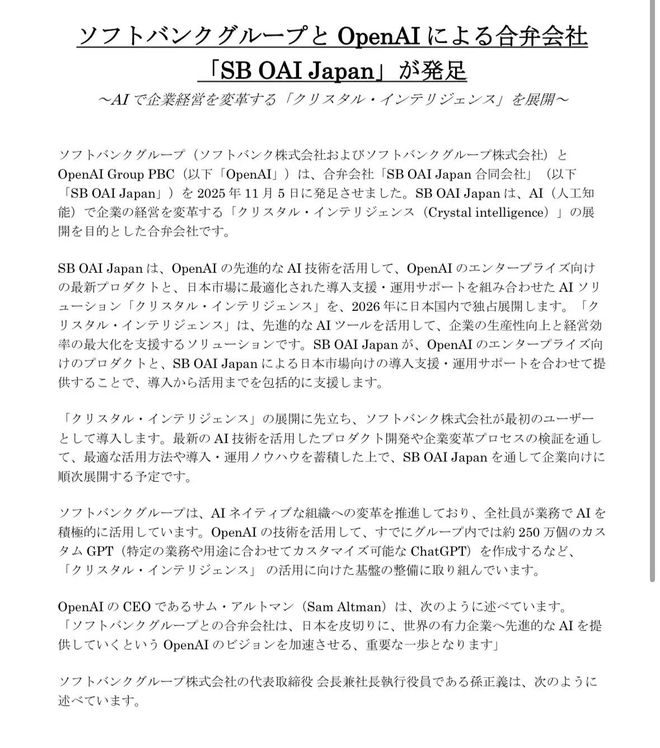
OpenAI CEO Sam Altman stated in the declaration: “Forming this joint venture with SoftBank Group will accelerate OpenAI’s vision of providing advanced AI technology to leading global enterprises, starting with Japan. This is an important step in advancing that vision.” SoftBank Chairman and CEO Masayoshi Son stated that an era of revolutionizing how people work and how companies operate is about to begin. “We will push the AI revolution to a new stage together with OpenAI,” he said.
Operate against explicit service contracts
Quality, latency, cost and failure behavior should be defined before optimization begins. This keeps local improvements from degrading the user-visible system. Version configuration and state.
Prompts, model routes, caches and data dependencies can change behavior without application code changes. Versioning makes regressions reproducible and rollback practical.
Prefer graceful degradation
When a dependency fails or capacity tightens, reduce optional work or use a clear fallback instead of allowing latency and errors to cascade through the full request path. Operate against explicit service contracts.
Quality, latency, cost and failure behavior should be defined before optimization begins. This keeps local improvements from degrading the user-visible system.
Version configuration and state
Prompts, model routes, caches and data dependencies can change behavior without application code changes. Versioning makes regressions reproducible and rollback practical. Prefer graceful degradation.
When a dependency fails or capacity tightens, reduce optional work or use a clear fallback instead of allowing latency and errors to cascade through the full request path.
Operate against explicit service contracts
Quality, latency, cost and failure behavior should be defined before optimization begins. This keeps local improvements from degrading the user-visible system. Version configuration and state.
Prompts, model routes, caches and data dependencies can change behavior without application code changes. Versioning makes regressions reproducible and rollback practical.
Prefer graceful degradation
When a dependency fails or capacity tightens, reduce optional work or use a clear fallback instead of allowing latency and errors to cascade through the full request path. How to read the development beyond the headline.
The reported development is most useful when separated into confirmed facts, forecasts and interpretation. Product timelines, pricing, supply constraints, regulation and customer adoption can all determine whether an early headline becomes a durable shift. Readers should update the thesis as concrete follow-through appears instead of treating an initial announcement or market reaction as the final outcome.
What to watch next
Useful signals include shipped products, independently observed performance, customer commitments, pricing changes, financial guidance and regulatory decisions. Those indicators show whether the development is changing real operations rather than only sentiment. Second-order effects can matter more than the announcement.
Technology moves often affect suppliers, competitors, developers and customers as much as the company named in the headline. The practical question is whether the event changes cost, capacity, standards, distribution or strategic options. Long-term scenarios should be evaluated against near-term milestones so ambitious forecasts remain clearly separated from confirmed execution.
Practical implementation check
Before applying this idea broadly, define a production baseline, the expected improvement and the failure conditions that would trigger rollback. Test with realistic traffic or representative workloads instead of relying on one isolated demo. Document ownership, monitoring and the assumptions that may become stale. This makes later changes easier to evaluate and prevents a one-time optimization from becoming an unexamined permanent dependency.
How to evaluate the story after the initial headline. Technology news is most useful when confirmed facts are separated from forecasts, market reaction and interpretation. Product timelines, pricing, supply, regulation and customer adoption can determine whether an announcement turns into a durable change.
The strongest follow-up signals are concrete: shipped products, independently observed performance, customer commitments, financial guidance or regulatory decisions.
Watch the second-order effects
Important developments often affect suppliers, competitors, developers and customers as much as the organization named in the headline. The practical question is whether cost, capacity, standards or strategic options change in ways that influence real decisions.


 admin