Alice
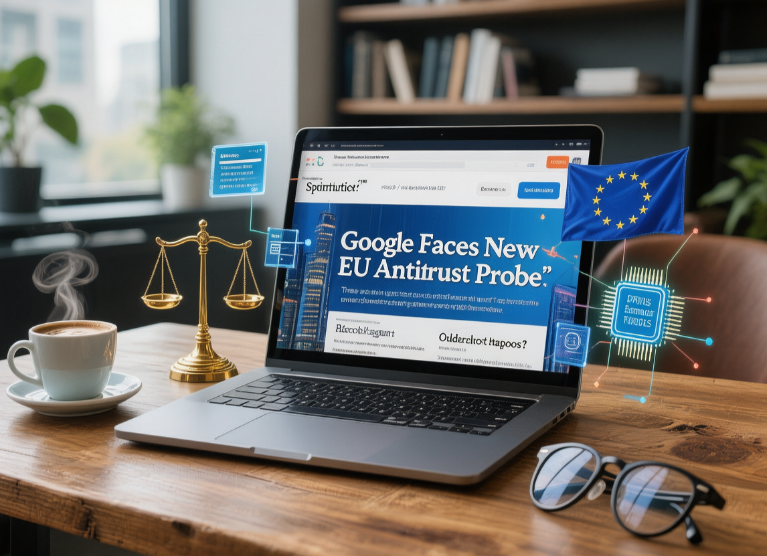
London/Brussels — Alphabet’s Google is facing a new competition investigation by the European Commission over its search ranking practices for news media outlets, the Financial Timesreported on Thursday, citing unnamed officials.
The probe will reportedly examine allegations that Google downgrades the search rankings of news publishers that host paid promotional content. The investigation will be conducted under the EU’s Digital Markets Act (DMA), which targets anti-competitive behavior by “gatekeeper” tech firms.
Google, which is already battling dozens of antitrust cases worldwide—ranging from its dominance in search and advertising to its mobile ecosystem—has yet to comment on the latest report.
The FTsaid the investigation stems from concerns that Google’s algorithm may disadvantage certain news publishers, particularly those that pay for visibility or rely on subscription models.
The DMA, which came into full effect last year, imposes strict rules on major digital platforms, including obligations to treat third-party services fairly and prohibit self-preferencing. Violations could result in hefty fines of up to 10% of global turnover, rising to 20% for repeat offenses.
This latest scrutiny adds to Google’s mounting regulatory challenges in Europe, where authorities have repeatedly accused the tech giant of abusing its market power. Earlier this year, the EU fined Google over €2.4 billion ($2.6 billion) for favoring its own shopping service in search results, and additional cases remain ongoing.
A spokesperson for the European Commission declined to confirm or deny the investigation but reiterated the bloc’s commitment to enforcing the DMA.
Google, for its part, has consistently defended its practices, arguing that its algorithms aim to deliver the most relevant results for users. However, critics—including news publishers and rival tech firms—have long accused the company of manipulating rankings to stifle competition.
The case is expected to draw close attention from media organizations and digital rights groups, who argue that fair treatment in search rankings is critical for the sustainability of independent journalism.
Define the production contract first
Agree on expected quality, latency, cost and failure behavior before optimizing individual components. A subsystem can look healthy while violating the end-to-end user objective. Make state ownership explicit.
Models, queues, caches and databases often hold overlapping representations. Each durable state should have one authoritative owner and a version so stale copies cannot silently win.
Test degradation and recovery
Simulate unavailable dependencies, stale caches and overload. Production systems need predictable fallbacks and a clear path back to normal operation rather than manual repair for every incident. Define the production contract first.
Agree on expected quality, latency, cost and failure behavior before optimizing individual components. A subsystem can look healthy while violating the end-to-end user objective.
Make state ownership explicit
Models, queues, caches and databases often hold overlapping representations. Each durable state should have one authoritative owner and a version so stale copies cannot silently win. Test degradation and recovery.
Simulate unavailable dependencies, stale caches and overload. Production systems need predictable fallbacks and a clear path back to normal operation rather than manual repair for every incident.
Define the production contract first
Agree on expected quality, latency, cost and failure behavior before optimizing individual components. A subsystem can look healthy while violating the end-to-end user objective. Make state ownership explicit.
Models, queues, caches and databases often hold overlapping representations. Each durable state should have one authoritative owner and a version so stale copies cannot silently win.
Test degradation and recovery
Simulate unavailable dependencies, stale caches and overload. Production systems need predictable fallbacks and a clear path back to normal operation rather than manual repair for every incident. How to read the development beyond the headline.
The reported development is most useful when separated into confirmed facts, forecasts and interpretation. Product timelines, pricing, supply constraints, regulation and customer adoption can all determine whether an early headline becomes a durable shift. Readers should update the thesis as concrete follow-through appears instead of treating an initial announcement or market reaction as the final outcome.
What to watch next
Useful signals include shipped products, independently observed performance, customer commitments, pricing changes, financial guidance and regulatory decisions. Those indicators show whether the development is changing real operations rather than only sentiment. Second-order effects can matter more than the announcement.
Technology moves often affect suppliers, competitors, developers and customers as much as the company named in the headline. The practical question is whether the event changes cost, capacity, standards, distribution or strategic options. Long-term scenarios should be evaluated against near-term milestones so ambitious forecasts remain clearly separated from confirmed execution.


 admin