Alice
Alice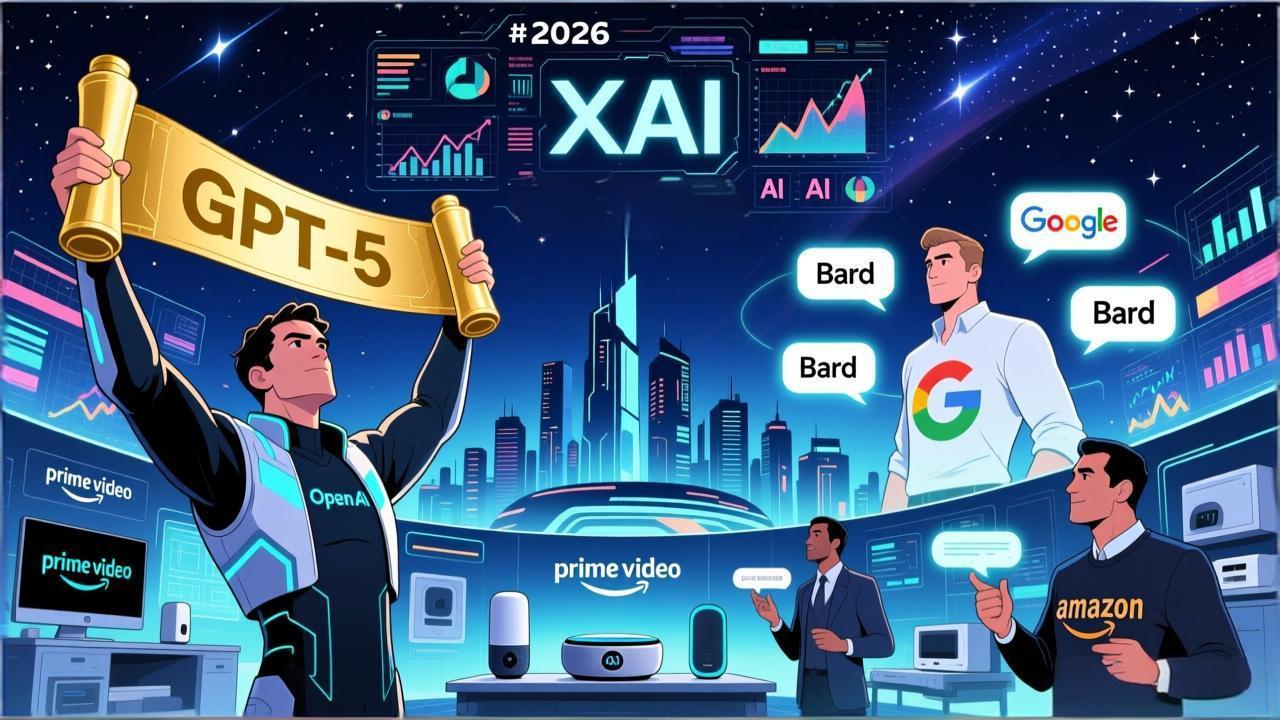
At the end of 2025, the U.S. AI circle completely “exploded”!
An executive order from the White House rewrote the regulatory rules, and the four major giants—OpenAI, Google, Amazon, and xAI—took immediate action. From consumer-grade tools to enterprise-level infrastructure, from chips to intelligent agents, the full-industry-chain “arms race” is in full swing.
From a third-party perspective, the core logic of this melee is already clear: Deregulation opens up the growth ceiling, and the giants’ technical routes and ecological layouts are reshaping the global AI power structure.
In the fourth quarter of 2025, the U.S. AI industry ushered in dual violent shocks from policy and market. The White House’s new regulatory policy has delineated a brand-new track for the industry, while tech giants such as OpenAI, Google, Amazon, and xAI have simultaneously launched all-round games. From consumer-grade products to enterprise-level infrastructure, from self-developed chips to intelligent agents (Agent), an “arms race” covering the entire industrial chain has entered a fever pitch. From a third-party perspective, the core logic of this change is clearly visible: Deregulation opens up growth space, and the giants’ technical routes and ecological layouts are reshaping the power structure of the global AI industry.
I. White House Sets Tone: AI Regulation Enters “Federal Monopoly,” Giants Embrace Expansion Opportunity
The policy shift is the “first domino” of this industry shock.
On December 11, 2025 (local time), U.S. President Trump officially signed the executive order “Ensuring the Development of a National Artificial Intelligence Policy Framework,” whose core is to establish a “single federal rule” for AI regulation—explicitly restricting the independent regulatory power of individual states, and even requiring the Department of Justice to set up a special task force to directly challenge the local AI regulations already issued by California, Colorado, and other states.
This move made Silicon Valley ecstatic! You know, for a long time, the biggest headache for tech companies has been the bureaucratic burden brought by differentiated state regulations. David Sacks, the White House’s AI affairs director, stated bluntly: “It makes no sense for 50 states to run in 50 different directions.”
Naturally, there were many objections. Institutions such as the California Economic Security Project sharply criticized: “This is handing over control of AI to tech giants!” But it is undeniable that the federal unified regulatory framework has truly cleared key obstacles for the large-scale expansion of the giants.
II. Battle for C-end Throne: The “Life-or-Death Game” Between OpenAI and Google
The consumer-grade AI track is the core battlefield for giants to compete for user attention, and the showdown between OpenAI and Google has entered a fever pitch.
1. OpenAI: Frenetic New Releases, But Facing Growth Bottlenecks
As the industry leader, OpenAI launched a “frenetic update mode” in the second half of 2025: the GPT-4o image generation function launched in March triggered a global upsurge, with 1 million new users per hour at its peak; at the end of the year, it launched the standalone Sora app and browser Atlas, among which Sora’s global downloads directly exceeded 12 million times, becoming a phenomenal creative tool of the year.
In addition, OpenAI is fully promoting the “Connector function”—allowing users to authorize it to access various applications such as G Suite and Microsoft Office Suite, trying to turn ChatGPT into a personal work management platform; at the same time, it is opening up the third-party developer ecosystem, ambitiously wanting to build a new consumer-grade AI platform.
But behind the glory lies hidden worries: Sora’s 30-day retention rate is less than 8%, far lower than the industry’s top level; Atlas’s user penetration rate has not exceeded 5%, and the growth bottleneck has already emerged.
2. Google: Blossoming in Multiple Directions, Breaking Through with “Scenario-based Layout”
Google, on the other hand, relies on the strong performance of the Gemini series models to continuously put pressure on OpenAI. In 2025, Google took a “multi-channel release” route: not only iterating models at the main Gemini entrance, but also launching popular tools such as Nano Banana image generation and Veo video generation, while frantically expanding the developer ecosystem through platforms such as AI Studio and Labs.
Unlike OpenAI, which focuses on a single product interface, Google’s killer feature is “scenario-based layout”—deeply integrating Gemini’s capabilities into the Workspace office suite. Its intelligent agents perform prominently in enterprise scenarios such as document processing and data visualization, successfully creating a differentiated advantage.
More importantly, Google’s TPU chip ecosystem continues to improve, forming a “hardware + software” dual-drive with the Gemini model, further consolidating its right to speak in the field of AI computing power.
III. B-end Infrastructure Battlefield: Amazon AWS’s “Full-Stack Ambition”
If the C-end is a battle for traffic, then the B-end enterprise-level AI infrastructure is a battle for strength, and Amazon Web Services (AWS)’s performance can be called “textbook-level.”
At the 2025 re:Invent conference, AWS completely tore off the label of “cloud computing vendor,” officially announced a comprehensive shift to “AI full-stack competition”, and launched a complete solution from self-developed chips to application-layer AI:
IV. Dark Horse Disrupts the Game: Musk’s xAI, Betting Big on the Future with Computing Power
- Chip Level: The business scale of Trainium self-developed training chips has reached billions of US dollars, with 1 million chips deployed; UltraServers launched based on the 3nm process Trainium3 have a single-cluster computing power of 362 PFLOPS (FP8), and the performance is more than 4 times that of the previous generation;
- Model and Platform Level: Launched the Nova 2 series of foundation models, and launched the enterprise-level training platform Nova Forge (supporting enterprises to integrate their own data to build exclusive models); added 18 open-source models to the Amazon Bedrock platform, including Google Gemma 3, NVIDIA Nemotron, etc., to build an open ecosystem;
- Application Level: Launched the Frontier Agents series of intelligent agents, covering scenarios such as operation and maintenance, security, and programming, trying to bind enterprise customers through AI and increase their dependence on cloud resources.
In addition to the established giants, Musk’s xAI has emerged as a “computing power radical,” becoming a key variable that disrupts the industry pattern.
On December 31, 2025, xAI high-profile announced the completion of the acquisition of its third data center, “MACROHARDRR,” making its overall computing power capacityclose to the 2GW level—this scale is enough to support the operation of about 1.1 million NVIDIA GB200 NVL72 GPUs, equivalent to pouring the electricity consumption of millions of American households into AI training.
To achieve the goal of “surpassing the sum of the industry’s computing power within five years,” xAI’s investment can be described as cost-no-object: by the end of 2025, more than 230,000 GPUs have been put into the training of the Grok series models, and the Colossus 2 data center has achieved stable power supply of 390 megawatts; it has purchased a 2-gigawatt gas-fired power plant from overseas, and also jointly built a permanent power generation facility in Mississippi, which is expected to add more than 1GW of power supply by the beginning of 2027.
However, the cost of aggressive expansion is also obvious: xAI’s monthly operating expenses have exceeded 1 billion US dollars, and a new round of financing is imminent.
V. Behind the Giant Melee: The “Three-Kingdom Struggle” for the Next-Generation AI Ecosystem
This seemingly chaotic struggle among giants is essentially a battle for the “next-generation AI ecosystem,” focusing on three core dimensions:
1. Technical Route: Full-Stack Capability Becomes Standard
“Self-developed chips + foundation models + Agent” has become the consensus of giants: Google has TPU + Gemini + Gemini Agent, Amazon has Trainium + Nova + Frontier Agents, and although Microsoft Azure has not directly disclosed it, through in-depth binding with OpenAI, it has integrated GPT capabilities into all scenarios such as Office and Teams.
2. Capital Investment: Money-Burning Intensity Hits a New Record
The total capital expenditure guidance of Amazon, Microsoft, Google, and Meta in 2025 exceeds 300 billion US dollars, among which Amazon’s single-quarter capital expenditure reaches 34.2 billion US dollars, a year-on-year surge of 61%, and most of it is invested in AI infrastructure.
3. Ecological Logic: The Struggle Between Open and Closed Routes
AWS integrates mainstream global models through Bedrock and takes the open ecosystem route; OpenAI tries to build a closed-loop ecosystem through the third-party application platform, and the game between the two will affect the future direction of the industry.
VI. Third-Party Perspective: 3 Key Characteristics of the U.S. AI Industry
After sorting out all the developments, from a third-party perspective, the U.S. AI industry at the end of 2025 presents three significant characteristics:
VII. Looking Ahead to 2026: These Suspenses Will Determine the Industry Pattern
The outcome of this giant melee is still full of variables:
- Two-way Drive Between Policy and Market: Federal deregulation paves the way for the expansion of giants, and the technological breakthroughs of giants in turn force the optimization of the policy framework;
- Competition Focus Shifts to Full-Stack Capability: It is no longer a competition of a single product. Whoever grasps the full-chain advantages of chips, models, and ecology will grasp the right to speak in the industry;
- Parallel Development of C-end and B-end: OpenAI and Google compete for users on the C-end, while Amazon and Microsoft build barriers on the B-end, forming a differentiated competitive pattern.
Can OpenAI break through the growth bottleneck through the third-party application platform? Can Google’s multi-scenario layout be converted into a stable market share? Can Amazon’s full-stack model win more enterprise customers? How long can xAI’s aggressive computing power expansion last? More importantly, how can federal regulation strike a balance between innovation and risk?
Regardless of the answer, this AI change at the end of 2025 has written a new opening chapter for the global industry.
Follow me for continuous tracking of giant dynamics and analysis of the latest trends in the AI industry~