Alice
Alice
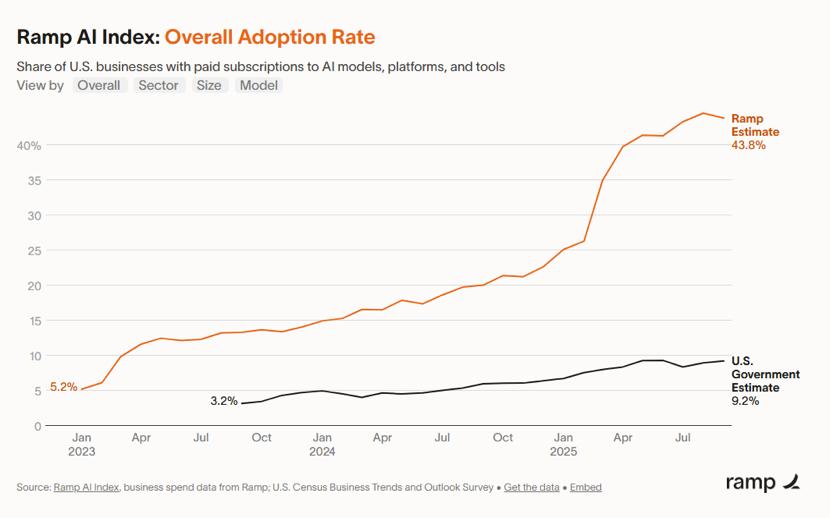
Since the release of ChatGPT in November 2022, generative artificial intelligence (AI) has witnessed rapid development. The competition among large – scale AI models has reached a fever pitch, with performance metrics constantly being refreshed and multimodal capabilities continuously enhanced. AI agents can now autonomously call upon various tools to complete increasingly complex tasks. AI model vendors have claimed that the era of Artificial General Intelligence (AGI) is just around the corner.However, in stark contrast to the rapid technological advancement, the commercial implementation of AI has lagged behind. Data from the US Ramp AI Index shows that the proportion of US companies adopting paid AI products has recently shown signs of stagnation, even declining.A research report released by the Massachusetts Institute of Technology (MIT) in July 2025, titled The GenAI Divide: State of AI in Business 2025, revealed that 95% of generative AI application projects either yield poor results or are terminated midway. This report even caused fluctuations in the US stock market.When the bold claim that “all industries need to be re – engineered with AI” meets the harsh reality of “high failure rates of AI projects”, we are compelled to ask: Where exactly does AI get stuck when transitioning from cool features to real – world industrial applications? And how can we cut through the fog to achieve a true value loop?
1. Business Process Restructuring and AI Path Planning
The performance metrics of AI models do not directly translate into commercial value. Currently, in most cases, AI cannot provide end – to – end solutions. Therefore, the practical application of AI requires identifying business segments where AI capabilities are relatively mature, a company’s data accumulation is relatively comprehensive, and the value is most significant, based on the boundaries of AI capabilities, combined with the business scenarios, needs, and pain points of the industry and the enterprise. This involves finding the minimum viable flywheel of input – data – benefit at the intersection of technology and demand. While generating economic returns, it also creates new data to feed back into model optimization, forming a virtuous cycle of continuous iteration.At this stage, the application of AI requires a process of work – flow segmentation and business – process restructuring. Tasks that AI is good at should be assigned to AI, while the remaining parts, whether due to AI’s limitations or insufficient data accumulation, still need to be completed by humans. The role of humans is to harness AI, bridge process gaps, allocate tasks and resources, and evaluate and correct results.We can compare this business – process restructuring process to path planning. For example, if you want to go from the Caohejing Development Zone in Shanghai to Fudan University, the fastest route is not a straight line on the ground but taking an elevated road. AI is like the elevated road, which can significantly increase travel speed but cannot cover the entire journey. So, ground roads are still needed to connect the two ends, just as humans play their part.There are three similarities between the business – process restructuring required for AI implementation and path planning:First, in path planning, you take the highway where it is available and the ground road where it is not. Sometimes, not only at the start and end points but also in the middle, the highway may not be connected, and you need to take the ground road. Similarly, AI can currently only handle certain business segments. Enterprises need to first break down the existing work – flow and assign the segments that AI is good at to AI. The remaining parts, including the connections between different AI segments and those requiring experience judgment or emotional interaction, still need to be handled by humans to ensure the completion of the entire task.Second, path planning requires knowledge of the starting point, the destination, and the highway map along the way. Similarly, if an enterprise wants to optimize its business through AI, it needs to know its own needs (equivalent to the starting and destination points of the journey) and also be clear about the current capabilities and boundaries of AI (equivalent to the highway map), so as to find value – creation points in the intersection of the two.Third, path planning requires dynamic adjustment. The progress of AI technology is like the continuous expansion of highways: sections that are not covered today may be opened tomorrow; the highway entrance that is on the east side today may have a closer one added on the north side tomorrow. Likewise, as AI capabilities improve, the process restructuring of enterprises and the division of labor and cooperation between AI and humans also need to be continuously adjusted.According to my observations, most enterprises currently still remain at the stage of directly applying AI tools. They neither break down the work – flow nor evaluate the adaptability of AI capabilities to business needs, failing to form the input – data – benefit flywheel, and the results are naturally not as expected.
2. Who Should Lead AI Implementation
As mentioned above, the implementation of AI requires both an understanding of AI and industry insights. However, industries are highly diverse, making it difficult to find individuals or entities with both qualities. Therefore, either those who understand AI need to learn about and transform industries, or those within the industry need to learn AI tools and use them to transform their own industries.
Path 1: Letting AI Experts “Enter the Industry” — The Rise of Front – End Deployment Engineers (FDEs)
The emergence of the “Forward Deployed Engineer (FDE)” model, which has gained popularity in Silicon Valley in recent years, represents this path. This model was first explored by the data analytics company Palantir. Its core is to station engineers familiar with AI and data analytics technologies in client enterprises, often for months or even half a year. The task of these engineers is not to sell products but to go deep into the front – line of business, understand the information about the enterprise’s production and operation, and finally find value – creation points within the boundaries of AI capabilities that align with the enterprise’s needs and pain points.Today, the FDE model of Palantir has become a “model for AI implementation” highly regarded in Silicon Valley. These front – end deployment engineers, who possess both AI technology and industry insights, have become the most sought – after group of entrepreneurs by investors.
Path 2: Letting Industry Insiders “Master AI” — Challenges and Opportunities
Another path is for industry practitioners to learn and master AI tools and then bring AI capabilities back to their own businesses. The aforementioned MIT report found that although only about 40% of companies are paid users of AI tools, more than 90% of companies have employees who use AI tools at their own expense to improve work efficiency. The author refers to this as the “shadow AI economy”.The “shadow AI economy” occurs at the individual employee level, targeting specific tasks rather than systematic application at the organizational level. It lacks coordination among employees and adaptation to the industry and the enterprise. On the one hand, this indicates that AI can indeed improve efficiency in many aspects of the business operations of most companies. It can be imagined that if these tools can be systematically adopted at the enterprise level, and their memory and context functions as well as adaptation to enterprise scenarios can be enhanced, their effects can be further amplified. On the other hand, matching AI tools to the needs of business segments requires evaluating the business process, which can be completed in a bottom – up and distributed manner, and may also require a certain degree of adaptation and customization.In the past, the high technical threshold and rapid iteration speed of AI made it very difficult for industry professionals to learn AI tools to empower and transform their industries. However, the recent explosion of AI programming has made this path possible.
3. AI Programming Activates Independent Industry Transformation
With the development of AI technology, AI programming tools have become increasingly powerful, significantly reducing the threshold and cost of software development and making it “democratized”. Tasks that used to take professional programmers months to complete can now be done by zero – base users. They can describe their requirements in natural language, use AI programming tools to generate code, and develop at least a product prototype that can validate concepts and test user feedback.Microsoft CEO Satya Nadella and Google CEO Sundar Pichai have publicly stated that about 20% – 30% of the software code generated by their companies currently comes from AI. Amazon Web Services (AWS) business CEO Adam Selipsky even claimed that 75% of AWS code is generated by AI. With the progress of AI technology, the proportion of AI programming will continue to expand. Industry leaders such as Jensen Huang, the founder of NVIDIA, and Sam Altman, the CEO of OpenAI, predict that in the future, programming will not necessarily require professional languages like C++ or Python, and “natural language as code” will become the norm.This change means that the core driving force of AI implementation is likely to shift from “technology – expert – driven” to “industry – practitioner – led creation”. The second path mentioned above becomes feasible. Industry professionals no longer need to wait for AI experts to “come and transform” their industries. Instead, they can actively learn, master, and use AI programming tools. Based on the specific scenarios, needs, and pain points of their industries, they can identify and build the minimum viable flywheel of AI applications in some business segments, solve specific problems, and create immediately visible value.In particular, AI programming is expected to make small and medium – sized enterprises (SMEs) a new force in AI implementation. Compared with large enterprises, SMEs do not need multi – level departmental coordination to promote AI transformation. Often, a manager and two or three key core members can determine the solution, enabling faster decision – making and iteration. Moreover, SMEs have fewer business segments. Even if they need to make up for their digital “homework”, they can directly build a digital system adapted to AI from scratch without having to transform complex legacy systems, resulting in lower difficulty and risk. Although SMEs may have had a disadvantage in terms of talent in the past, AI programming tools have greatly alleviated this problem.