Alice
Alice
According to multiple sources familiar with the matter, to break the deadlock, Apple is planning to “rent” Google’s ultra-large-scale AI model with 1.2 trillion parameters, developed by its old rival, at an annual cost of around $1 billion. The aim is to conduct a thorough “heart transplant” on its widely criticized voice assistant, Siri.
Once the news broke, the capital market responded swiftly, with Google’s parent company Alphabet seeing its stock price surge by as much as 3.2% at one point.
Parameters are a key indicator for measuring the complexity of an AI model. The parameter scale of Google’s model makes Apple’s current model (with 150 billion parameters) used in the cloud version of “Apple Intelligence” seem rather inadequate in comparison.
It is reported that before making this decision, Apple had conducted comprehensive tests on models from several companies, including OpenAI’s ChatGPT and Anthropic’s Claude. Ultimately, it set its sights on Google earlier this year. Behind this choice lies Apple’s urgent need to rapidly enhance Siri’s capabilities, and this deal is widely seen by the outside world as Apple’s public admission of being “a step behind” in the AI race.
What role will Google play in Siri’s “heart transplant”?
This is not a simple technology procurement but an initiative aimed at conducting a “bottom-up reconstruction” of Siri.
The project, internally codenamed “Glenwood,” is led by Mike Rockwell, head of Vision Pro, and Craig Federighi, head of software engineering. Its goal is very clear: to leverage Google’s technological prowess to lay the foundation for the new version of Siri (codenamed “Linwood”), set to be released next spring.
Unlike the early idea of embedding Gemini as an independent chatbot into Apple’s system, this collaboration adopts a more sophisticated “component-based” approach.
According to the agreement, Google’s Gemini will primarily handle the core functions of Siri’s “brain,” namely the “summarizer” responsible for information integration and the “planner” responsible for planning complex tasks. These two components determine Siri’s ability to understand complex instructions and plan multi-step tasks.
It is worth noting that Apple has adopted a strict data security strategy: all AI processing will be completed on Apple’s self-built private cloud computing servers, ensuring that user data remains isolated from Google’s infrastructure at all times. This model of “borrowing capabilities without sharing data” not only meets technological needs but also upholds Apple’s long-standing privacy commitment.
A low-key “marriage”: Is Google willing to play the “behind-the-scenes hero”?
Unlike the public collaboration where Apple sets Google as the default search engine in Safari browser, this AI collaboration has been particularly low-key.
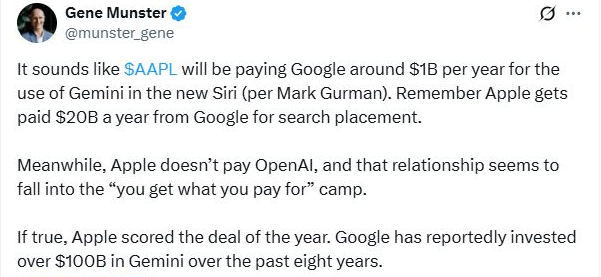
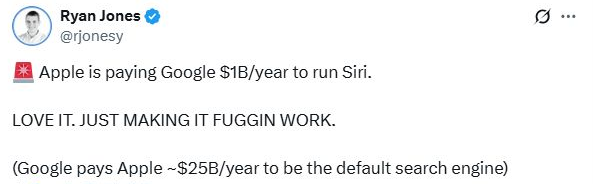
Many netizens, including well-known analyst Gene Munster, have compared Apple and Google’s current collaboration to their long-standing cooperation in the search engine field, noting that the 1billionAppleispayingannuallyforSiriisafarcryfromthe25 billion Google pays to be the default search engine on the iPhone.
Apple plans to treat Google purely as a “behind-the-scenes technology supplier” and is not expected to engage in high-profile promotional activities. This arrangement not only avoids “endorsing” a competitor but also ensures a consistent user experience.
During Apple’s most recent earnings call, CEO Tim Cook stated that Siri might eventually offer more chatbot options beyond the current ChatGPT choice.
According to reports, the new version of Siri is scheduled to be released next spring. Given that there are still several months until the release, relevant plans and partnerships may still change. Both Apple and Google’s spokespersons declined to comment.
Is it a “win-win” deal?
Once the news emerged, the capital market immediately cast its vote with real money. On Wednesday, the stock prices of both companies briefly surged to their intra-day highs: Apple’s stock price rose slightly by less than 1%, while Google’s parent company Alphabet’s stock price soared by as much as 3.2% at one point.
However, behind this seemingly “win-win” situation, it is interpreted as Apple’s “public admission of defeat.”
Dan Ives, an analyst at Wedbush Securities, put it succinctly: “This clearly shows that in the AI arms race, no company can go it alone.”
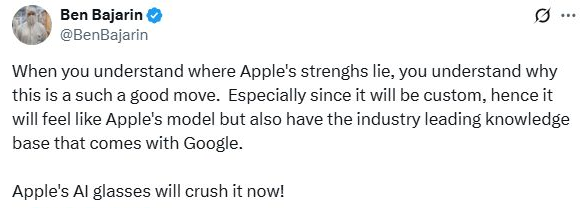
Most netizens support Apple’s move, considering it the wisest decision the company has made.
In fact, Apple is not the only one “seeking help.” A host of tech companies, such as Snap, have already chosen to develop their AI capabilities on Google’s Vertex AI platform.
Is it a “temporary job” or a “long-term meal ticket”?
Despite leveraging external forces, Apple has not given up on its determination to develop independently. The company still adheres to a “two-pronged” strategy: on the one hand, it uses external resources to quickly bridge the gap; on the other hand, it accelerates its in-house development.
Multiple sources familiar with the matter emphasized that Apple views Google’s technology as a “temporary solution,” with the ultimate goal of replacing it with its in-house model. It is reported that Apple’s in-house model team is fully engaged in developing a cloud-based model with 1 trillion parameters, which is expected to be put into use as early as next year.
However, the road to catching up is not smooth. Google’s Gemini 2.5 Pro version currently ranks at the top of most authoritative leaderboards and is still undergoing continuous iteration. At the same time, Apple is also facing the challenge of AI talent drain, including the departure of its model team leader.